Whole of property load assessment
Every significant load, its duty cycle and its starting characteristics. Motors are the ones that catch people out.

Off Grid Power Systems · NSW & QLD
Generation, storage, backup and switchgear designed together as one system, so your property has power that holds up when the weather and the workload do not cooperate.
Plenty of rural properties end up with a collection of parts rather than a system: an array sized by one supplier, batteries chosen by another, a generator bolted on afterwards, and a switchboard that grew by accretion. It works until the first hard week, and then everyone finds out which component was the weak link.
CW Rural Power & Electrical designs off grid power systems as a whole. Generation, storage, backup and distribution are specified against each other and against the property's real load, so the system behaves predictably under pressure rather than only on a good day.
Chris Weaver holds electrical contractor licences in NSW (163931C) and QLD (1512016), CEC Solar Accreditation, and a High Voltage Cable Jointer qualification. On larger rural properties that last one is what keeps a job from needing a second contractor.
Every part specified against every other part.
Every significant load, its duty cycle and its starting characteristics. Motors are the ones that catch people out.
Generation, storage, inverter capacity and backup specified against each other so no single component undersizes the rest.
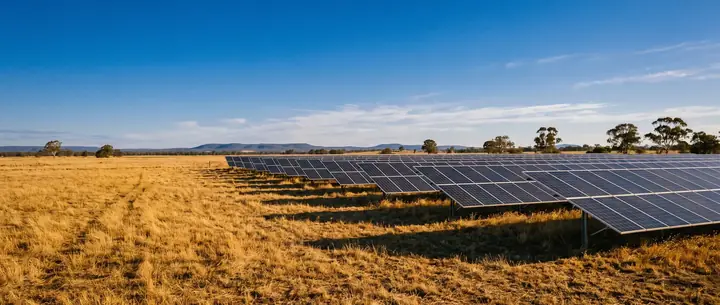
Generation sized to the autonomy target you agreed, with mounting chosen for the site rather than for convenience.
Chemistry and capacity matched to depth of discharge, cycle life and the temperature the bank will actually live in.
Generator sizing, auto start logic and changeover, so it runs when it is genuinely needed and not when it is not.
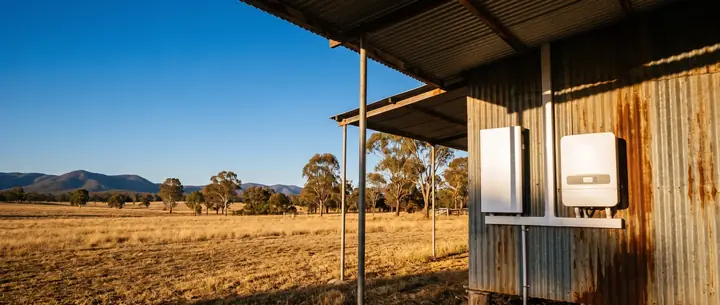
Correct protection, isolation, earthing and labelling, documented for whoever opens the board next.
Design first, then equipment. Not the other way around.
What is on the property now, what is planned, and what has to keep running when everything else can wait. Water and refrigeration usually top that list.
We work out real consumption and peak demand rather than estimating from floor area, because the pumps and the workshop change the answer completely.
How many days the property needs to run without meaningful sun. That number is a decision you make with us, not an assumption we bury in the quote.
A full specification with a single line diagram, showing what each component does and why it is that size.
Array, storage, inverter, backup and switchboard installed and integrated as one system on an agreed schedule.
Tested under real load, labelled, monitoring configured, documentation handed over, and we are contactable afterwards.
Most of these are design decisions rather than equipment faults, which is why they are so much cheaper to get right at the start than to correct later.
Not every job is a new build. We regularly assess existing systems on properties that have changed hands or grown past what the original install was sized for, and that assessment is honest: sometimes the answer is a battery replacement and a controller change, and sometimes the existing gear is not worth building on. See also off grid solar and battery installations.
Qualified for complex systems. Built for remote jobs.
Array, batteries, inverter, backup and switchboard specified together. Systems assembled from separately chosen parts are where the weak link hides.
Qualified High Voltage Cable Jointer, which matters once rural infrastructure gets past the size a standard install can handle.
Labelling, single line diagrams and commissioning records, so a future fault takes hours to find rather than days.
A complete system covers generation, usually solar, a battery bank sized to carry the property overnight and through poor weather, an inverter capable of the property’s peak and starting loads, protection and switchgear, earthing, and normally a backup generator with auto start. All of it is specified together so no single component undersizes the rest.
A typical rural property runs from several days to a couple of weeks on site once equipment is delivered, depending on array size, cable runs and how much existing wiring needs rework. Design and procurement happen before that, and we give you an honest timeline at quote stage.
Yes, provided it is designed for the real load. Dairy plant, irrigation pumps, cool rooms, welders and workshop equipment all have starting characteristics that need to be accounted for. This is exactly the sort of work we do rather than an exception to it.
Properly designed systems fail gracefully. Backup generation, sensible protection and clear labelling mean a fault takes the property to a reduced state rather than to darkness, and the next electrician on site can find the problem quickly.
We design with headroom wherever the budget allows, leaving room in the switchboard, cable and inverter capacity for the shed, the pump or the extra dwelling that tends to arrive later. Expanding a system that was never planned for it is the expensive path.
Regularly. We audit existing installations, tell you plainly what is sound and what is not, and quote on either repairing what is there or replacing it, whichever genuinely makes sense.
Ready to talk through your power needs? Call directly or send us a message and we'll get back to you promptly.
0483 347 898 chris@standalone.energy